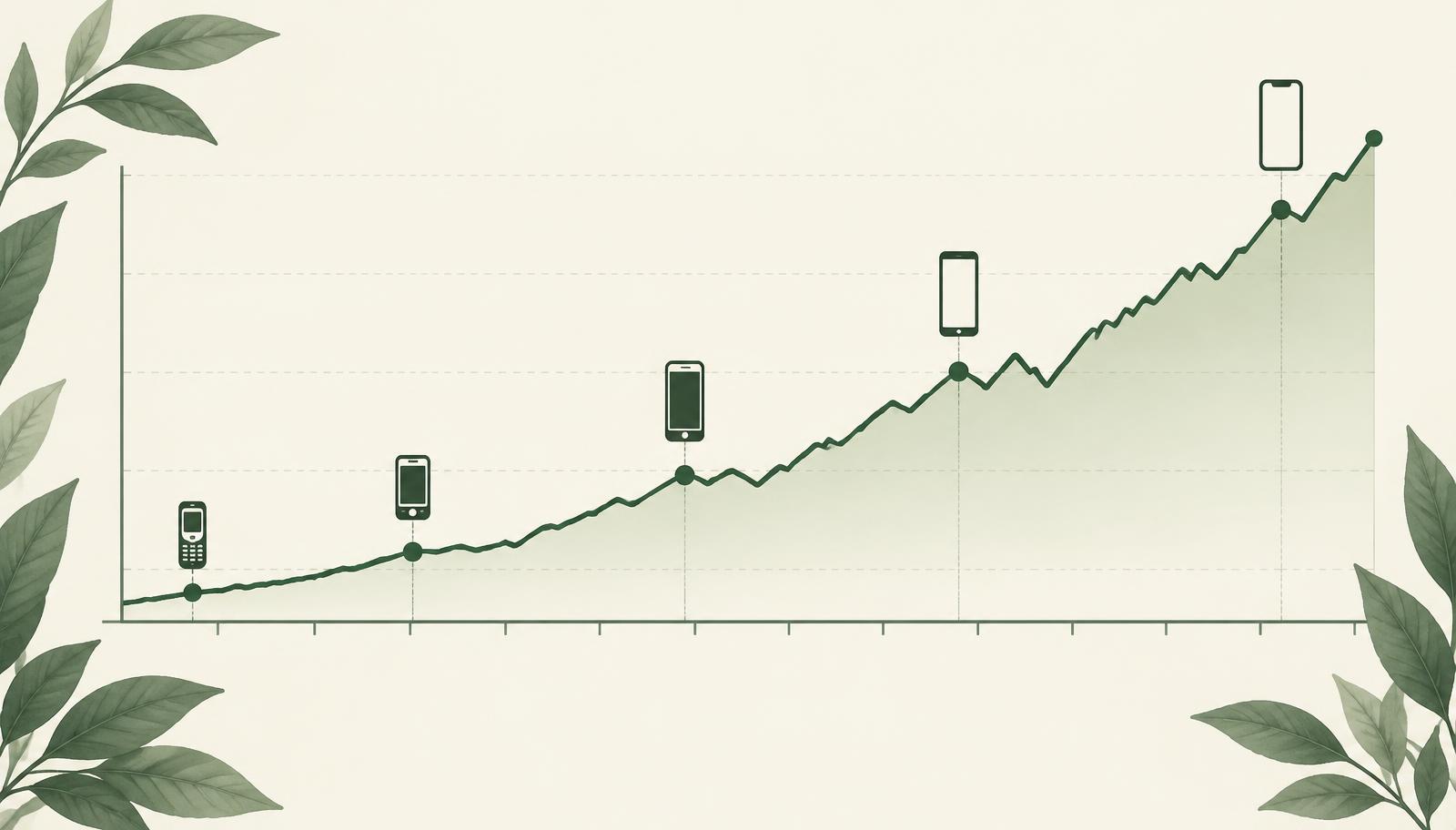
Every September, the same question trends: does Apple stock go up after an iPhone launch? It sounds like it should be answerable, and it is — there are twenty launches on the record now, and the price history is public.
So we pulled it. Below is Apple's split-adjusted move on each announcement day, 30 calendar days later, and 12 months later, for every iPhone generation from the original in January 2007 to the iPhone 18 Pro and iPhone Duo event on 9 September 2026.
The answer turns out to be more interesting than yes or no.
This is a historical pattern study, not investment advice, and nothing here is a recommendation to buy or sell any security.
The iPhone 18 launch, in numbers
Apple's September 2026 event introduced the iPhone 18 Pro, the iPhone 18 Pro Max, and the iPhone Duo — the company's first foldable, at $1,999. Notably, there was no standard iPhone 18: Apple split its release cadence, pushing the iPhone 18, 18e and Air 2 into spring 2027.
Apple closed at $315.34 on launch day, down about 0.3% from the prior session. A $1,999 foldable, the biggest form-factor change in a decade, and the stock barely moved.
That is not an anomaly. That is the pattern.
Apple's move around every iPhone launch (2007–2026)
| Generation | Announced | Close (split-adj.) | Day move | 30 days | 12 months |
|---|---|---|---|---|---|
| iPhone | 9 Jan 2007 | $2.77 | +8.3% | −6.9% | +93.8% |
| iPhone 3G | 9 Jun 2008 | $5.43 | −2.2% | −4.1% | −21.4% |
| iPhone 3GS | 8 Jun 2009 | $4.30 | −0.6% | −4.6% | +73.3% |
| iPhone 4 | 7 Jun 2010 | $7.51 | −2.0% | +3.1% | +32.3% |
| iPhone 4S | 4 Oct 2011 | $11.14 | −0.6% | +8.2% | +81.0% |
| iPhone 5 | 12 Sep 2012 | $20.12 | +1.4% | −6.0% | −27.7% |
| iPhone 5s / 5c | 10 Sep 2013 | $15.21 | −2.3% | −1.0% | +46.2% |
| iPhone 6 / 6 Plus | 9 Sep 2014 | $21.57 | −0.4% | +3.1% | +14.3% |
| iPhone 6s | 9 Sep 2015 | $24.66 | −1.9% | +1.8% | −2.2% |
| iPhone 7 | 7 Sep 2016 | $24.78 | +0.6% | +5.3% | +51.4% |
| iPhone 8 / X | 12 Sep 2017 | $37.44 | −0.4% | −3.0% | +39.5% |
| iPhone XS / XR | 12 Sep 2018 | $52.23 | −1.2% | +0.5% | +2.5% |
| iPhone 11 | 10 Sep 2019 | $51.99 | +1.2% | +6.2% | +118.7% |
| iPhone 12 | 13 Oct 2020 | $117.36 | −2.7% | −1.4% | +17.1% |
| iPhone 13 | 14 Sep 2021 | $144.47 | −1.0% | −2.9% | +5.4% |
| iPhone 14 | 7 Sep 2022 | $152.97 | +0.9% | −10.2% | +14.5% |
| iPhone 15 | 12 Sep 2023 | $173.95 | −1.7% | +2.5% | +26.9% |
| iPhone 16 | 9 Sep 2024 | $219.08 | +0.0% | +3.9% | +6.6% |
| iPhone 17 | 9 Sep 2025 | $233.49 | −1.5% | +8.4% | +35.1% |
| iPhone 18 Pro / Duo | 9 Sep 2026 | $315.34 | −0.3% | pending | pending |
Methodology: closes are split-adjusted and dividend-adjusted, taken from public market data for the announcement date of each generation. "Day move" is the close on the announcement day versus the prior close. "30 days" and "12 months" use the first trading day on or after the calendar anniversary. Announcement dates are used rather than in-store dates, because the announcement is the information event.
What the pattern actually shows
Three things stand out, and none of them is "launches move the stock."
1. Launch day is close to a non-event. Excluding the original 2007 keynote, Apple's average announcement-day move is roughly −0.8%, and it was negative in 14 of the 20 events. Not one launch since 2007 produced a day-one move larger than 3% in either direction.
The reason is simple: by keynote day, almost nothing is new. Supply-chain reporting and component leaks price the product in months ahead. The keynote confirms what the market already assumed — and confirmation is not information.
2. The 30-day window is a coin flip. Eleven of the nineteen completed 30-day windows were positive, nine negative, with a spread from −10.2% (2022, which had far more to do with a broad market drawdown than with the iPhone 14) to +8.4% (2025).
3. The 12-month window looks completely different. Seventeen of nineteen 12-month windows were positive, several enormously so. But attributing that to the launch is a mistake: it mostly reflects Apple compounding through the 2010s and 2020s alongside the wider market, plus the growth of Services. The launch is a date on the calendar, not the cause.
The honest summary: iPhone launches are a poor trading signal and a poor reason to buy the stock. What has historically moved Apple is earnings and guidance — the quarters where the units, the average selling price and the margin actually show up.
The three launches that did matter
Three exceptions prove the rule, and all three worked on a longer horizon than launch day.
iPhone 4, June 2010. Fell 2.0% on announcement day — into a quarter that redefined smartphone demand. Twelve months on: +32.3%, as Apple moved from challenger to category-definer.
iPhone X, September 2017. A 0.4% dip on the day and −3.0% over the following month, on scepticism about a $999 phone. The "supercycle" showed up in later quarters; twelve months on, +39.5%. The launch-day reaction was wrong in direction and magnitude.
iPhone 12, October 2020. Down 2.7% on the day the 5G iPhone arrived. The 5G replacement wave was a multi-quarter revenue story, not a one-day one.
In each case, the market's day-one verdict was a bad predictor of the following year. That should make anyone cautious about reading much into a launch-day tick — up or down.
The foldable question, and how analysts are split
The iPhone Duo is the genuinely new variable in 2026, and coverage reflects real disagreement rather than consensus:
- Morgan Stanley has been the constructive voice, with a price target around $360 and an estimate of roughly $14B of incremental December-quarter revenue from the Pro and foldable mix.
- Jefferies has carried an Underperform stance, arguing the foldable's bill of materials compresses gross margin and that $1,999 limits volume.
Both readings sit on the same facts. A higher-priced flagship lifts revenue per unit and costs more to build; whether the mix shift helps or hurts depends on volumes nobody has yet. Any figure quoted here belongs to the analyst who published it — we don't publish price targets, and neither should anyone who isn't accountable for them.
If you want the wider context on how much weight to put on any of this, our guide to how AI portfolio analysis actually works covers what automated analysis can and cannot infer from headlines like these.
What to understand before buying any single stock
This is where the iPhone question usually leads, so it's worth answering directly. Before a single company becomes a meaningful part of your portfolio, five things are worth knowing about it — Apple included:
- Revenue concentration. iPhone still drives roughly half of Apple's revenue. One product line, one replacement cycle, one set of consumer conditions.
- Services mix. Services carry much higher gross margins than hardware and grow more steadily. The proportion of profit coming from Services is arguably the more important trend than any launch.
- Valuation versus growth. A high multiple embeds expectations. Meeting expectations is then merely adequate; missing them is expensive.
- China exposure. Both a large market and a manufacturing base — a single geography carrying two different kinds of risk.
- Execution risk on something new. A first-generation foldable is a hardware bet with yield, durability and repair unknowns.
None of these says buy or avoid. They're the questions whose answers you should be able to give before a position gets large.
The part that's actually about your portfolio
Here is the thing most Apple articles skip. The risk in owning Apple is usually not Apple. It is how much of your portfolio Apple has quietly become.
Winners grow into concentration on their own. A 5% position that triples becomes a 14% position without you ever placing a trade, and by then your portfolio's outcome depends more on one company's product cycle than on any allocation you consciously chose. Many people holding an S&P 500 index fund plus individual Apple shares have far more single-name exposure than they think, because the index is itself heavily weighted to a handful of megacaps.
Two practical habits:
- Know your real weight, including what's inside your funds. That means looking through ETFs, not just at your direct holdings.
- Decide the ceiling before you need it. Pick the maximum share of your portfolio any one company may occupy, then check it periodically rather than emotionally.
This is exactly what PieFolio AI's Portfolio Health score measures — concentration in single names, sectors and geographies, alongside diversification and income quality, across every account you hold. If you want the broader income and allocation framing, how to build passive income in 2026 and the best dividend stocks of 2026 approach the same portfolio from the cash-flow side, and the calculators hub has the projection tools.
A Shariah note
For readers screening on faith grounds: Apple's business activity screens broadly acceptable under the widely used standards — it sells hardware and software, not alcohol, gambling, conventional banking or adult content.
The complications are financial rather than operational. Apple holds a large interest-bearing cash and securities position and carries conventional debt, so it is the balance-sheet ratio screens — debt to market capitalisation, interest income as a share of revenue — that determine compliance under AAOIFI-style methodology, and different index providers reach different conclusions in different quarters. Where interest income exists, the purification (dividend cleansing) step applies.
Our halal investing guide walks through the screens and the purification calculation in full, rather than reducing it to a single yes or no.
FAQ
Does Apple stock go up after iPhone launches? Not reliably. Across twenty launches from 2007 to 2026, the announcement-day move averaged roughly −0.8% excluding the original 2007 keynote, and was negative in 14 of 20 events. Thirty-day outcomes were close to a coin flip. Longer-term gains track earnings and the broad market far more than any launch date.
When is the iPhone 18 released? The iPhone 18 Pro, 18 Pro Max and the foldable iPhone Duo were announced on 9 September 2026. Apple split the cycle: the standard iPhone 18, the 18e and the Air 2 are expected in spring 2027.
What happened to Apple stock on iPhone 18 launch day? It closed at $315.34, down about 0.3% on the day — squarely within the muted range every launch since 2007 has produced.
Does Apple pay a dividend? Yes, quarterly, though the yield is small relative to the share price; Apple's shareholder returns lean heavily on buybacks. If dividend income is your goal, screen on yield, coverage and growth rather than on brand — our dividend calculator projects the income a given portfolio produces.
Is Apple stock halal? Its business activities screen broadly acceptable, but compliance depends on balance-sheet ratio screens around interest-bearing cash and conventional debt, which vary by provider and by quarter. See the halal investing guide for the screens and the purification step.
Price figures are split- and dividend-adjusted closes from public market data. Analyst views are attributed to the firms that published them. This article is for information only and is not investment advice, a recommendation, or an offer to buy or sell any security. Past performance does not predict future returns.